Tutorial 5: A2A agents¶
This tutorial moves one delegation edge from in-process communication to A2A without changing the MAS workflow or either agent's reasoning logic. It then runs a mixed topology where one specialist is remote and two remain local.
A2A is not required to validate the MAS graph or agent behavior itself. It is a production deployment concern for remote peer communication, but it should never force the agent team to rewrite the workflow, re-specify prompts, or duplicate protocol handling in every app. The point of the tutorial is to show exactly how that separation works in practice.
Once the transport is moved into infra, the team can keep using the same stable agent ids, actions, and logical delegation contracts while the platform handles AgentCard discovery, protocol negotiation, task lifecycle semantics, and protocol compliance. That allows a single certified integration to benefit every agent that needs it, without repeating the same protocol work in multiple teams.
You will learn how to:
- separate delegation topology from communication infrastructure;
- expose an existing agent through A2A without rewriting it;
- discover an A2A peer's interfaces through its AgentCard;
- dispatch local and remote delegations through
AgentCommContract.
The big win: one infra manifest, no MAS rewrite¶
This tutorial is the communication equivalent of Tutorial 4. The MAS graph and agent definition are stable; only the infra layer changes how the target is reached.
In practice, the exactly same local delegation still resolves to the same
logical target id, but the runtime can switch that target from a local in-process
agent to an A2A peer by changing an Application endpoint manifest. The model,
workflow, and delegation intent do not change.
That is the real power of the design:
- business logic: which agent is called and why
- agent identity: stable target ids and delegation contract
- infra: URL, protocol, transport, endpoint exposure, and auth policy
A2A manifest mapping and defaults¶
The complete reference is A2A developer reference and infra.md.
The remote-agent config is an Application endpoint keyed by the exact agent id:
apiVersion: infra/v1
kind: Application
metadata:
  name: a2a-agents-local
spec:
  endpoints:
    schedule_agent:
      protocol: a2a
      usage: use-and-deploy
      url: http://127.0.0.1:9006
      expose: true
The important fields to know are:
| Field | Default / common value | Meaning |
|---|---|---|
spec.endpoints.<agent_id>.protocol |
a2a |
Selects the A2A transport implementation for that route. |
spec.endpoints.<agent_id>.url |
required | The remote agent endpoint or public URL. |
usage |
use |
use consumes the peer; deploy exposes a local A2A server; use-and-deploy does both. |
expose |
false |
Set to true when the endpoint should be publicly advertised. |
headers |
{} |
Optional auth metadata for the remote peer; prefer env:VAR over static secrets. |
timeout |
project default | Optional request timeout if the runtime supports a per-endpoint timeout. |
The important point is that the A2A-specific features are not embedded in the MAS logic. They live in the infra endpoint config and are discovered through the agent's AgentCard. The MAS manifest only names the target id; the endpoint map resolves it to the correct remote peer.
One contract, two communication paths¶
The logical and deployment layers answer different questions:
| Layer | Owns | Does not own |
|---|---|---|
| MAS manifest | Agent ids, local definitions, workflow, delegates_to topology |
Peer URLs and protocols |
| Agent manifest | Prompt, model, tools, skills, behavior | Whether callers are local or remote |
Application infra |
Endpoint id, protocol: a2a, URL, headers, timeout, exposure policy |
Delegation intent |
The delegation layer sends every task through
AgentCommContract.send(target_agent_id, task, ...). The local plugin invokes
an in-process runtime. The A2A plugin sends the same logical task through an A2A
client. The workflow does not branch on protocol.
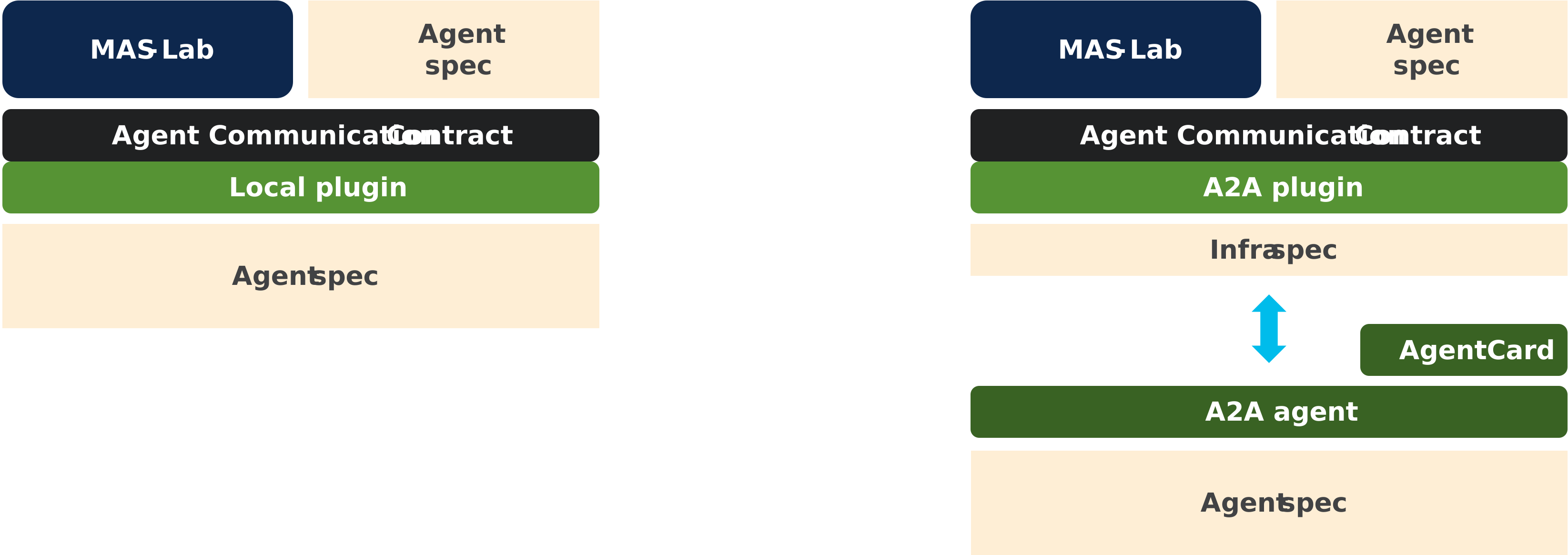
Figure 1: The MAS graph and agent behavior stay fixed. Infra can replace a local communication handler with A2A while preserving the same target id and contract.
Producer: expose an existing agent¶
The mixed example uses Tutorial 2's schedule_agent. The canonical
mixed-agents.infra.yaml
endpoint has the same id:
endpoints:
  schedule_agent:
    protocol: a2a
    usage: use-and-deploy
    url: http://127.0.0.1:9006
From the repository root, serve the unchanged schedule agent:
mas-ctl serve \
  "$PWD/docs/tutorials/02-creating-a-mas/agents/schedule-agent/agent.yaml" \
  --infra-ref "$PWD/library-samples/infra/mixed-agents.infra.yaml"
Inspect the generated protocol advertisement:
a2a card get http://127.0.0.1:9006
The AgentCard is not a second agent specification. It is the protocol-facing view generated from the existing manifest: identity, skills, capabilities, and supported interfaces. The prompt, tools, and runtime behavior remain in the agent manifest.
Consumer: mix local and A2A agents¶
Tutorial 2's MAS already delegates from moderator to three ids:
workflow:
  entry: moderator
  nodes:
    - id: moderator
      delegates_to: [schedule_agent, itinerary_agent, concierge_agent]
Run that unchanged MAS against the producer. --bind is usage: use, so
this process does not steal port 9006 from mas-ctl serve:
mas-ctl run-mas docs/tutorials/02-creating-a-mas/mas.yaml \
  --bind schedule_agent=a2a://127.0.0.1:9006/ \
  -q "Plan a trip and compare the available transport schedules."
The same --infra-ref file on run-mas is the all-in-one path: hosted
use-and-deploy specialists bind in this process. Do not combine that with
a separate mas-ctl serve on the same port.
The resulting route table is:
| Agent id | Discovered owner | Dispatch |
|---|---|---|
schedule_agent |
Explicit Application endpoint with protocol: a2a |
Remote A2A message |
itinerary_agent |
Materialized local agent, no remote endpoint | In-process turn |
concierge_agent |
Materialized local agent, no remote endpoint | In-process turn |
An explicit peer endpoint overrides a materialized local agent with the same id. This lets the same MAS manifest run as one process during development and as a distributed system in another environment.
When a hosted agent has usage: deploy or use-and-deploy, run-mas (and
chat / tui) still drive the conversation in-process. Advertised URLs bind
in the same process so you can interrogate the live instance
(a2a card get http://127.0.0.1:9001) without a second mas-ctl serve.
Specialists listed as usage: use stay remote and need their own
mas-ctl serve (or --bind). All four commands share
mas.ctl.session.exposure.
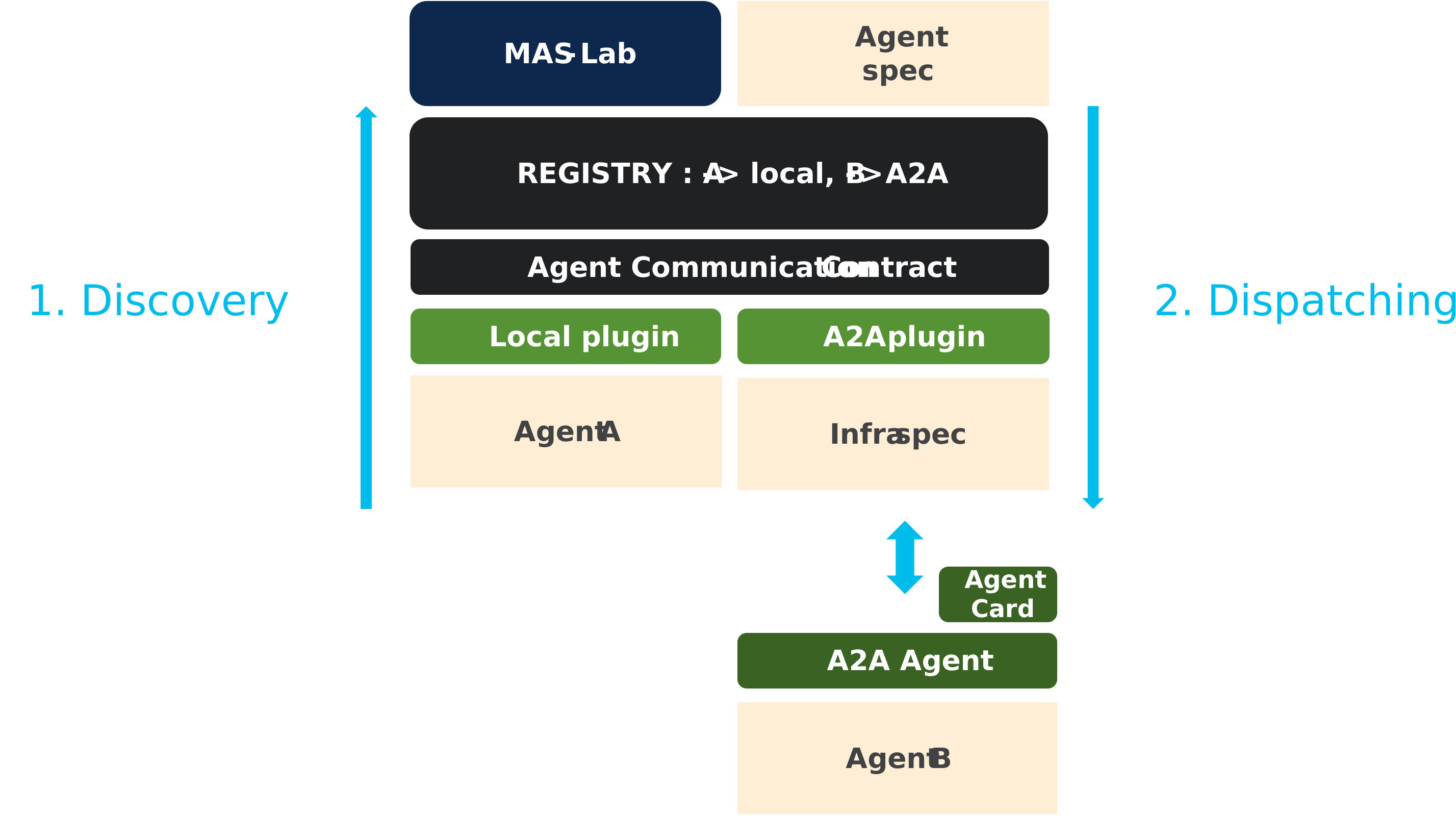
Figure 2: Route discovery combines local materialized agents with infra
endpoints. Dispatch resolves the target id and invokes one implementation of
AgentCommContract; the A2A client then reads the peer AgentCard to select a
supported wire binding.
What happens during discovery and dispatch¶
- MAS-Lab materializes agents referenced by the MAS manifest and records their ids as local routes.
- It reads
delegates_toto determine which target ids need routes. - Active
Applicationendpoints are keyed by those same agent ids. - An endpoint with
usage: useoruse-and-deploycreates an external agent-communication provider and overrides the local route for that id. - When delegation targets
schedule_agent, the A2A client resolves its AgentCard and selects an advertised interface. Other target ids stay local. - The response crosses the same delegation boundary back to the moderator, regardless of transport.
Missing routes fail when the table is built, and duplicate identity is resolved explicitly by infra rather than by network guessing. Protocol selection is therefore deterministic and visible in configuration.
Switch back to local communication¶
Run the same MAS without the infra reference:
mas-ctl run-mas docs/tutorials/02-creating-a-mas/mas.yaml \
  -q "Plan a trip and compare the available transport schedules."
All three specialists now use the local provider. No MAS graph, agent prompt, delegation tool, or specialist implementation changed.
Session continuity: contextId is the session id¶
A2A has no separate "session" concept of its own — it reuses the protocol's
contextId. Two requests with no contextId are two independent sessions;
the first response's contextId is the session id, and sending that same
value on a later request attaches to the same session instead of minting a
new one:
from library_ioa.plugins.a2a.client import A2AClient

client = A2AClient(url="http://127.0.0.1:9006")

first = client.send_message("Plan day one around the morning train.")
print(first)  # look for "context_id" — top-level on a Task response,
              # nested under "result" on a Message response
context_id = first.get("context_id") or (first.get("result") or {}).get("context_id")

second = client.send_message("Now add day two.", context_id=context_id)
client.close()
mas-a2a (the CLI used above) does not expose a --context-id flag yet, so
reusing a session from the command line means calling A2AClient directly,
as above, rather than mas-a2a --message. The server-side mapping is exact:
the runtime reads the inbound contextId and uses it as session_id for
that turn; omitting it mints a new one (library_ioa/plugins/a2a/exposure.py).
Two callers that do send the same contextId concurrently share one
linearized turn queue — the second caller's turn is queued, not dropped or
run in parallel. That queueing, plus attaching to a session's live control
surface from a separate process, is the subject of
Tutorial 8 — Control attach and debug, which
builds directly on this same session-id mechanism.
Direct protocol check¶
You can still test the remote agent independently of MAS dispatch:
a2a send -a http://127.0.0.1:9006 \
  "Find transport schedules from Luminara to Verdantia."

mas-a2a --a2a http://127.0.0.1:9006 \
  --a2a-transport JSONRPC \
  --message "Find transport schedules from Luminara to Verdantia."
What changed¶
Only infra changed. A2A owns peer discovery, transport negotiation, task
lifecycle, and wire messages; MAS-Lab keeps the workflow, target ids, agent
behavior, and AgentCommContract stable.
Reference material¶
- A2A developer reference and infra.md § A2A agent endpoints — full endpoint manifest fields.
- Kernel operations and
Thin waist — where
contextId/session id and the concurrent turn queue sit in the runtime's architecture. - A2A compliance workflow — deterministic profiles and official TCK evidence.
- Next: Tutorial 8 — Control attach and debug.