MAS-Lab v0.2: Skills, Tools, and Agents That Can Work Together
MAS-Lab is an open-source foundation for building multi-agent systems the way you'd build any other production software: from a declarative specification, with a runtime that enforces it, and with experiments and traces that show what actually happened. v0.1 gave us a way to specify, run, and test agent logic. v0.2 connects that same specification to the rest of the agentic world — skills, tools, and other agents — without rewriting the agent to do it.
One system, from experiment to operation
MAS-Lab is not another agent framework or test harness. It is a continuity architecture: one versioned specification gives the system an identity across design, experiments, execution, and operations. The spec declares roles, tools, delegation, and policies; the runtime applies those boundaries; isolated plugins provide capabilities without burying them in agent logic. Traces and results then refer back to the system that was actually declared and run.
In the lab, we can vary an agent's skills, models, context, or topology and retain comparable runs. The paper labs show what reproducible artifacts look like: rerunnable experiments that regenerate their figures and tables. In production, we can deploy only the capabilities needed, while keeping observability and governance part of the same contract. None of this guarantees that a model's answer is correct. It shifts the cost of building reliable agents from reconstructing what happened after a failure toward specifying, testing, and observing behavior from the start. v0.2 carries that continuity through to the protocols agents actually use to reach skills, tools, and each other.
Skills without coupling them to an agent
We already had skills in v0.1. In v0.2, library-skills expands that support
around the agentskills.io format: discover SKILL.md by name, disclose the
instructions on demand, load accompanying resources, and run embedded scripts.
Skills can add expertise or executable capabilities through an overlay without
changing the base agent specification. The same skill directory remains portable
to other harnesses that support agentskills.io; it is not tied to MAS-Lab's
runtime or to a copy of the agent prompt.
Tools and peers across protocols
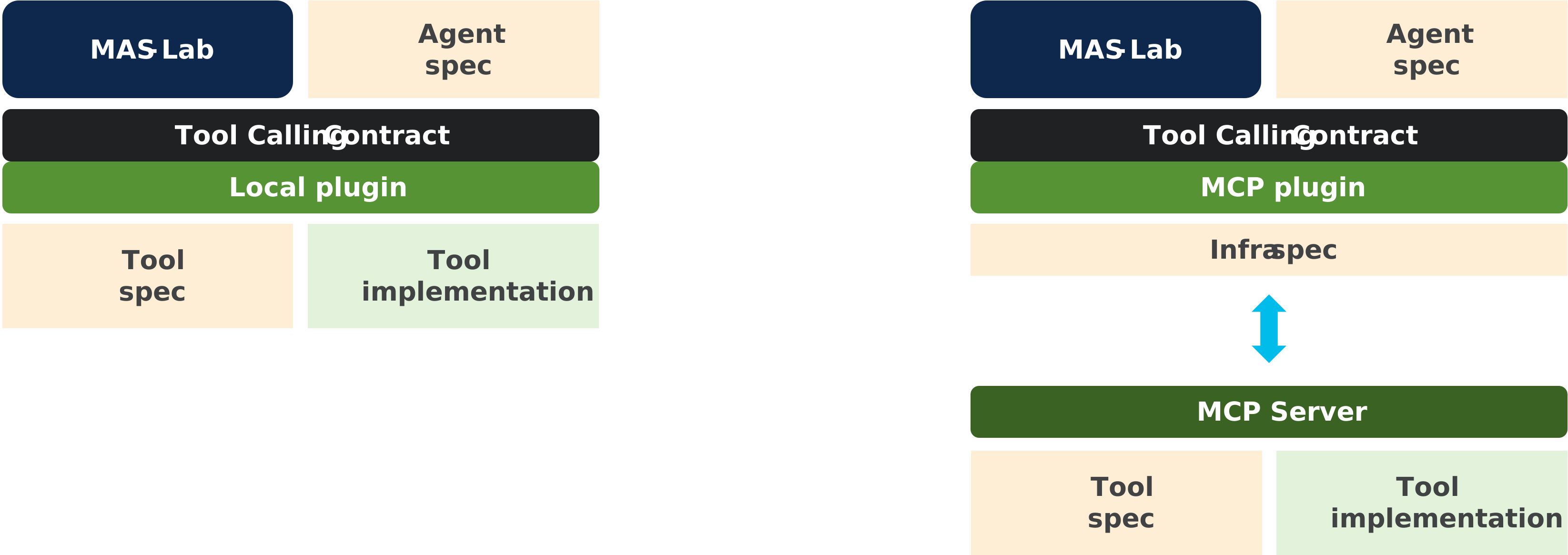
With MCP, the agent still asks for the same logical tool. As
Tutorial 4 shows, moving from a
local experiment to an MCP provider is an infrastructure switch: set
protocol: mcp in a ToolServerRegistry, then specify any non-default
transport settings. To use an existing remote MCP server, provide an infra
manifest with its address and any required access details. Discovery and routing
stay behind the tool contract, so the agent does not change; the tutorial even
combines a local calculator and remote web search in one turn.
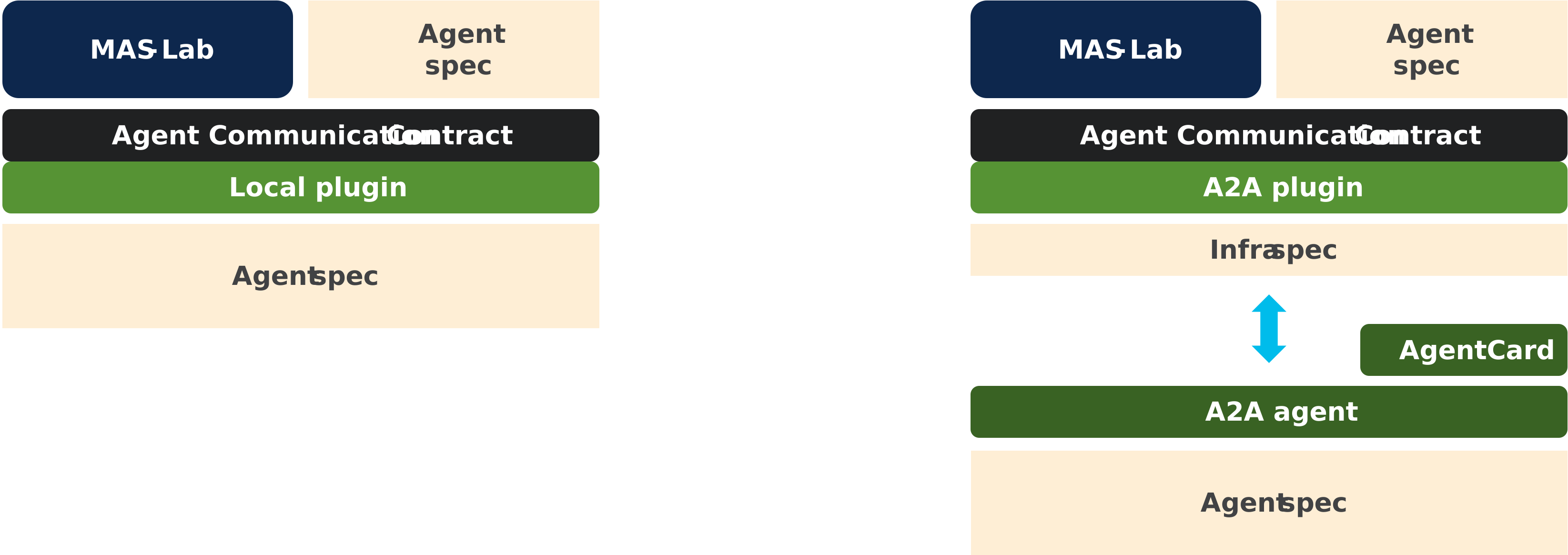
A2A applies the same idea to delegation: select protocol: a2a for an agent
endpoint and supply its URL and any other non-default settings. An existing
agent can be exposed with mas-ctl serve --protocol a2a, or the MAS can connect
to a remote peer by declaring its endpoint. The agent ids, workflow, and
delegation contract remain unchanged. Tutorial 5
demonstrates a mixed local/remote team; a single application can also use MCP
tools and A2A peers together.
The adapters are measured against official conformance suites, rather than asking each application to implement protocol details by hand. The v0.2 results cover 98.3% of required checks for the MCP 2026-07-28 stateless revision and 99/99 executed A2A requirements; the A2A TCK exercises 79.8% of the specification. These results do not amount to blanket protocol certification.
Built with real workloads
Beyond protocol integration, v0.2 grew from our research and prototypes within Outshift and contributions from teams using MAS-Lab. It also brings new features, improvements, and bug fixes.
An example of MAS-Lab in use is the published study of silent cognitive failures: agents can skip verification or agree on the wrong answer while ordinary operational signals stay green. MAS-Lab helped turn that observation into repeatable research. We defined an SRE triage use case under two coordination patterns, varied specific failure conditions through overlays, and automated repeated runs and trace processing to compare outcomes and diagnostic metrics. The same experiment machinery lets us scale beyond a handful of anecdotes, and further artifacts from that work are on the way.
This also supports our ongoing research on the Internet of Cognition (IoC): how agents share intent and context, reason together, and detect cognitive failures before a team commits to the wrong result. MAS-Lab gives us a way to reproduce and measure those failures. Cognitive observability means looking at what agents represented, checked, and committed to across their interactions, not only whether requests succeeded or latency stayed low.
Observability and governance are first-class concerns that we will keep strengthening in future releases.
What comes next
Keeping behavior separate from transport makes integrations easier to test and reuse; we plan to extend this approach to more protocols in the next releases. It reflects why we participate in the Agentic AI Foundation (AAIF): standards make systems interoperable, while a shared specification and reproducible evidence let us ask whether they behaved as intended. We want to build reliability in from the design phase: make contracts explicit, test isolated plugins, and catch structural errors before deployment. That reserves the more expensive runtime checks for what cannot be prevented earlier, including silent failures in production that require cognitive observability. This is both an accuracy goal and a way to reduce the cost of verification.
We presented MAS-Lab and its protocol extensions across the agentic stack at AGNTCon Europe (slides linked from the session page; recording available online). Read the v0.2 release for the full notes and source archives, follow Tutorial 0 to try it, or explore the repository and its contribution guide. Issues, feedback, and contributions are welcome.