Introducing MAS-Lab: Bringing Reliability and Engineering Discipline to Multi-Agent Systems
Multi‑agent systems are having a moment.
In a short time, what once required significant engineering effort—custom routing, shared state, retries—has become accessible to almost any developer. With modern tooling, collaborating agents that reason, call tools, and delegate tasks can now be assembled in hours, not weeks. What used to be a research challenge has become a developer workflow.
A Shift Is Happening — Faster Than We Can Control
We see this shift everywhere: copilots, autonomous assistants, orchestration pipelines. Systems that once required careful integration now emerge over a weekend, often built by a single engineer iterating directly on prompts.
As the barrier to building falls, the bar for operating these systems rises. Developers must iterate without breaking behavior they cannot fully explain. Operations teams must deploy, monitor, and govern what they cannot fully observe. Researchers and reviewers need evidence that a change caused an outcome—not just a lucky run.
Across roles, the need converges: guarantees that what works in the lab will hold in production.
The Problem: Multi-Agent Systems Are Easy to Build… but Hard to Trust
Multi‑agent systems are easy to prototype—and difficult to trust. Agent logic, orchestration, observability, and control are often entangled in prompts, ad hoc code, and runtime behavior. The result is a system that is hard to validate, reproduce, or predict beyond the demo path.
What teams learn from experimentation is often weak evidence of how the system will behave under real conditions—production budgets, stricter policies, and unpredictable failures. There is still no principled way to show that a system behaves as designed, or to explain why it doesn't.
Example: A Trip Planner
Consider a simple multi‑agent trip planner. A coordinator receives a request, breaks it into subtasks, and delegates to agents that fetch schedules, compute routes, and estimate cost.
You try a few queries—plan a trip to Rome, find the cheapest itinerary, optimize for time. The demo works: structured output, visible reasoning, clean tool calls.
Then you prepare it for production. You add memory for user preferences, tighten reasoning patterns, and introduce a budget cap. Each change is small and reasonable. Together, they are not.
The same query now returns different results. Handoffs become inconsistent. Latency and cost drift. You rerun the experiment and get another outcome. You roll back a change—and behavior does not fully revert.
There is no obvious place to debug because there is no single system definition to inspect. Instead, there is a web of prompts, tool calls, implicit rules, and interactions that only emerge when the workflow runs end to end.
This gap becomes critical when moving from demo to production. Developers cannot isolate changes without side effects. Operations cannot govern what is not explicitly declared. Reviewers cannot attribute outcomes to design choices rather than noise.
This is not a missing dashboard or a better prompt template. It is a structural problem: multi‑agent workflows need explicit intent, controlled execution, and evidence that carries from development into production.
Introducing MAS-Lab
MAS‑Lab is an open‑source toolkit for building, running, and validating multi‑agent workflows with engineering discipline rather than demo luck. It addresses the structural gap: when intent, execution, and evidence live in different places, no team can move a system from development to operations with confidence.
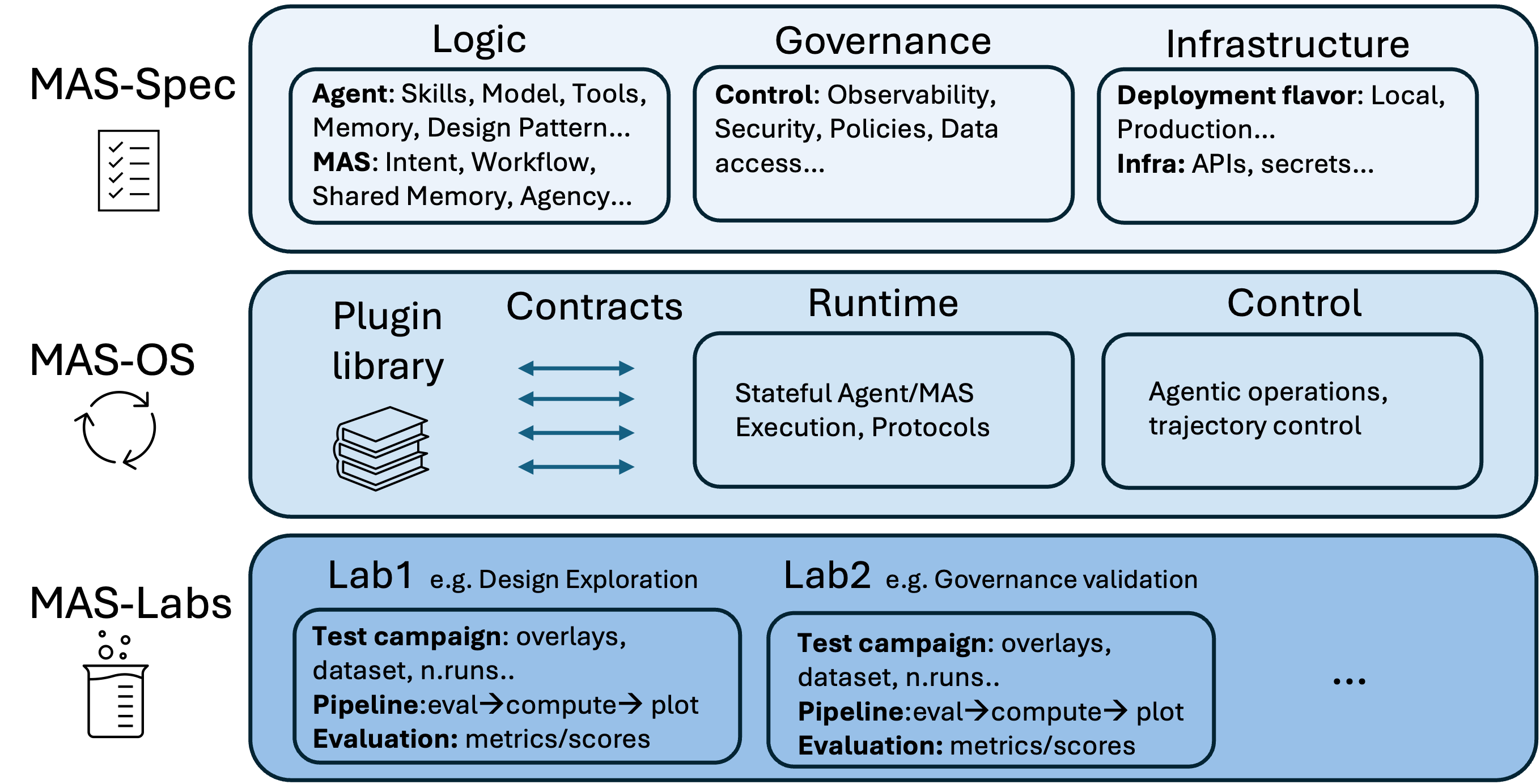
MAS‑Lab organizes work around three coupled building blocks (fig.1):
- Specification: a versioned definition of agents, roles, tools, delegation, constraints, and policies
- Runtime: controlled execution that enforces that definition, protects state and resources, and records what happens
- Labs: repeatable experiments that vary one factor at a time and produce comparable, reusable evidence
The goal is not another agent framework. It is a layer that makes workflows explicit, execution controlled, and results reproducible—so guarantees can accumulate from design through production.
Who is MAS-Lab for ?
MAS‑Lab addresses the production handoff described earlier—the point where systems must move from promising demos to reliable operation. The difference is perspective: the same foundations serve developers, operators, and reviewers in different ways.
For developers, the goal is to change one thing without breaking everything else. The specification provides a versioned system identity that can be diffed, branched, and benchmarked. The runtime isolates workflow structure from incidental prompt changes. Labs turn “it worked once” into comparable runs across scenarios and overlays. Iteration becomes systematic rather than anecdotal.
For operations teams, the priority is control and governance. The specification defines the contract: which agents exist, what they can access, and which policies apply. The runtime enforces that contract before actions reach external systems, while producing auditable traces. Labs generate readiness evidence that can support release reviews—not just developer experimentation.
For researchers and reviewers, the need is attribution. The specification makes the independent variable explicit. The runtime preserves causal traces across agent interactions. Labs keep other factors stable while varying one dimension, allowing outcomes to be tied to design choices rather than dismissed as noise.
These are not separate products, but three perspectives on the same foundation. That is why the internals that follow are shared rather than duplicated.
What sets MAS‑Lab apart is not a feature, but a separation. In most systems today, logic, orchestration, governance, and observability are entangled. There are no clear boundaries, and small changes propagate unpredictably across the whole system.
The three layer architecture presented in Fig. 1 is what allows to break this entanglement.
How MAS-Lab works
Overview
The three layers in MAS-Lab address three main core questions.
| Component | Core Question it answers |
|---|---|
| Specification | What is this workflow, exactly—and which version are we evaluating? |
| Runtime | How is that definition enforced during execution, including failures and contention? |
| Labs | What changes when we vary a design choice or policy under controlled conditions? |
Guarantees build across these layers: some are defined in the spec, others are guaranteed by design, or validated in isolation and composition, and the rest are enforced and observed at runtime.
Specification comes first
MAS‑Lab starts from the specification—not from a loose collection of agents. That choice is foundational.
A specification gives a workflow a stable identity: something you can version, compare, and reference in results. It anchors observability, because traces attach to defined roles, tools, and delegation paths—not to an ad hoc prompt. It also enables analysis, since experiments depend on a declared baseline.
This reflects a broader shift in the ecosystem (e.g., Agent Cards, OASF, AgentSpec): standardizing boundaries so implementations can evolve without breaking the system. MAS‑Lab extends this principle beyond interfaces to the full workflow lifecycle—linking intent, execution policy, experiments, and artifacts to the same declared system.
Teams can bootstrap by inferring specs from existing systems. This eases adoption but weakens guarantees—implicit intent is harder to version, govern, and benchmark. The end state is explicit specifications, with frameworks and tools plugged in—not reconstructed afterward.
A specification defines, at minimum:
- the agents and their roles
- delegation patterns and state flow
- allowed tools and external resources
- constraints and policies
From this, developers design workflows, operators inherit enforceable contracts, and reviewers gain a stable object to evaluate.
Runtime provides controlled execution
Once intent is declared, execution must enforce it.
The MAS‑Lab runtime treats every meaningful action as part of a controlled lifecycle: validated against policy, executed with guardrails, and recorded with context. It mediates access to internal state and external resources, while protecting workflows from concurrency issues, partial failures, and timing drift.
Some guarantees are structural—built into how the runtime enforces delegation, tool use, and policy gates. Others come from validating components in isolation and composing them under the same specification. Where design‑time guarantees fall short, observability extends validation into live execution.
This is where operations gain confidence: the workflow that passed review is the one that runs—with traces explaining who did what, under which policy, and with what outcome.
Labs: experiments with provenance
The final layer makes workflows measurable.
Labs apply controlled, declarative variations—changing one parameter at a time (policy, topology, or configuration) while keeping the specification and runtime constant. Each run produces artifacts designed for comparison, regression detection, and readiness assessment—not just final scores.
This is how teams move beyond demos to evidence: the same declared system, exercised under defined conditions, with results that remain reproducible and explainable when production behavior diverges.
MAS-Lab benefits across agentic application lifecycle
A common drawback of today's agentic development is rebuilding the workflow between development, test, and production. Validation on a toy graph does not predict behavior on the deployment graph.
MAS Lab uses one specification as the thread through the lifecycle. Developers edit and version it. Labs benchmark variants of it. Operations deploy and monitor executions of it. A failing lab run or a drifted trace refers back to the same identity operators saw in change review.
Continuity is what makes earlier guarantees portable. Design choices, runtime enforcement, and experimental evidence attach to one workflow definition instead of three incompatible copies.
Not every failure announces itself like a tool error or a policy violation. Some are silent: wrong delegation that still returns an answer, stale memory that sounds plausible, coordination drift that only appears under load. These are the failures you cannot fully rule out when writing the spec.
That is why observability in MAS Lab is built-in. It continues validation into execution, with provenance and attribution: which agent acted, on what basis, after which handoff, under which policy version.
Design and labs establish what should hold. Runtime enforcement catches structural violations early. Observability and guardrails cover what remains: cognitive and coordination failures that emerge only when real workloads, real latency, and real policies interact.
In practice that means:
- By design — declared roles, allowed tools, policy gates, and execution mediation.
- By validation — building blocks and compositions tested in labs before promotion.
- By observation — traces, audits, and reactive controls when behavior diverges without a clean error signal.
This is also where systematic learning belongs. When workflows are observable under control, tradeoffs become visible: richer context may help recall but hurt precision; stricter governance may add latency but reduce risk; more agents may not improve outcomes. Those insights feed the next specification revision rather than another round of prompt guessing.
This layered approach ensures continuity across the lifecycle. Design establishes intent. Validation tests it under variation. Runtime enforcement prevents structural violations. Observability captures what only emerges in real conditions—deviations that do not trigger clear errors.
This is also where systematic learning emerges. When workflows are observable and controlled, trade‑offs become visible: richer context may improve recall but reduce precision; stricter policies may add latency but reduce risk; adding agents may not improve outcomes. These insights feed directly into the next specification revision—turning iteration into structured improvement rather than trial and error.
Cognitive and coordination failures
The remaining gap is where the hardest failures live.
Even with a well‑defined specification, validated components, and enforced execution, some failures only appear at runtime. These are not structural errors but behavioral ones: incorrect delegation that still returns an answer, stale memory that sounds plausible, coordination drift that appears only under load.
This is the natural extension of the same lifecycle. What cannot be guaranteed by design or by validation must be handled by observation and reaction.
In the Internet of Cognition framing, these are cognitive system failures—requiring comparison between intended behavior (the specification) and actual execution (the trace), with enough context to attribute the cause.
MAS‑Lab closes this final loop. Observability provides the signals, and the shared system identity makes them actionable: teams can trace a failure back to the exact workflow version, policy, and interaction pattern that produced it.
From there, remediation becomes systematic. The fix feeds back into the same lifecycle—updating the specification, refining policies, or extending experiments—rather than remaining a one‑off patch.
How MAS Lab fits in today's ecosystem
The agentic ecosystem is evolving quickly—and unevenly. Teams today rely on a growing set of tools: agent frameworks such as LangGraph, CrewAI, and AutoGen to build workflows; protocols like MCP and A2A to connect agents to tools and peers; and a wide range of observability, evaluation, and experimentation platforms (LangSmith, Braintrust, Phoenix, Langfuse, Humanloop, and others) to measure behavior and performance.
Each layer solves a real problem. But they are often assembled around workflows that have no shared system definition. As a result, intent, execution, and validation become fragmented—and what works in a demo is difficult to carry into production with confidence.
MAS‑Lab does not compete with this ecosystem. It complements and unifies it.
Its starting point is different: the specification. Instead of embedding system behavior across prompts, framework code, and tooling, MAS‑Lab defines workflows as explicit, versioned specifications—agnostic to how agents are implemented or which framework they run on.
Around that shared definition, MAS‑Lab integrates existing tools as plugins:
- observability platforms provide traces and signals
- governance layers enforce policies and access controls
- context/memory and tool systems contribute capabilities
- evaluation and experimentation tools generate comparative evidence
This shifts the model from tool‑centric to system‑centric. Tools are no longer loosely stitched together—they attach to a common workflow identity that persists from development through production.
Adoption does not require a clean slate. MAS‑Lab supports brownfield scenarios by importing or inferring specifications from existing systems—whether built with coding agents like Claude, orchestration frameworks like LangGraph, or custom stacks. This provides an immediate on-ramp, while allowing teams to progressively move from inferred to fully declared specifications as their needs for reproducibility, governance, and validation grow.
The goal is simple: reuse the ecosystem as it is, but make the system itself explicit, controlled, and measurable end to end.
Join us
Multi-agent workflows are becoming a standard way to build with language models. They will stay fragile and hard to operate until intent, execution, and evidence are engineering concerns, not afterthoughts.
MAS Lab is our open source contribution to that practice: specify workflows, run them under control, experiment with provenance, integrate the protocols and tools you already use, and carry guarantees from design into production.
Explore the repository at https://github.com/outshift-open/mas-lab. Run the demos and tutorials, declare a system in YAML, work through the labs on design, governance, and memory, and connect your framework through the plugin interfaces. Issues, adapters, and production workloads are how the model hardens.
We are early. The ecosystem is moving toward declared, portable agent workflows, and MAS Lab is built to advance with it, not apart from it.